Meta Ads for Ecommerce Brands Focused on Profit
You don’t need social media marketing … you need profit.
Most Meta agencies optimize for platform metrics. We optimize for contribution margin. Every budget decision, creative test, and scaling call is made inside the Prophit Engine: a financial operating system that keeps Meta tied to your P&L at all times.


Built for Contribution Margin and Forecasted Scale
Scaling Meta used to mean tightening campaign structure, reducing learning phase spend, and incremental ROAS gains.
Today, Meta operates as a creative-driven, AI-optimized auction. Targeting has broadened, automation has expanded, and platform-reported ROAS often diverges from financial reality. Without incrementality modeling, scale can erode margin quickly.
If your reporting sounds like:
- “We maintained a 3.4 ROAS.”
- “Spend increased 28% month-over-month.”
- “CPA improved.”
And contribution margin still feels unstable or cash flow tightens as spend rises, you’re lacking a financial operating system that links Meta decisions to the P&L.
Meta Ads Inside the Prophit Engine
This operating system is built for predictable, profitable ecommerce growth.
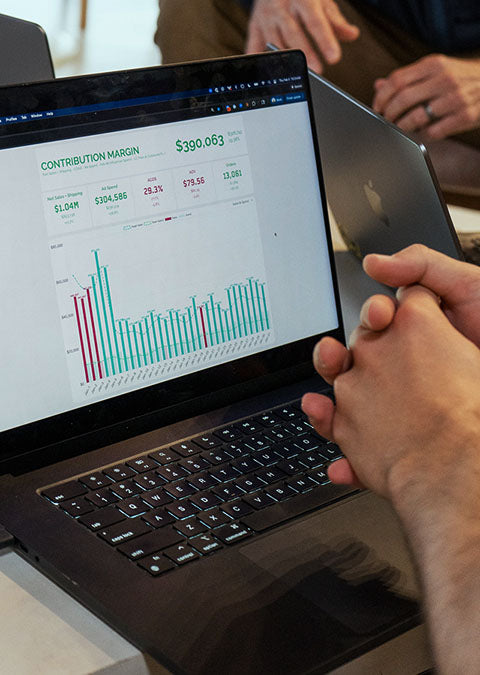
Inside Meta, it brings creative strategy, media buying, financial forecasting, incrementality testing, spend curve modeling, and cohort-level lifetime value (LTV) analysis into one system.


One Engineer at the Center
Instead of separate creative strategists, buyers, and analysts working in silos, a dedicated Prophit Engineer owns the forecast and execution, then manages Meta against contribution margin and business objectives, not platform metrics.
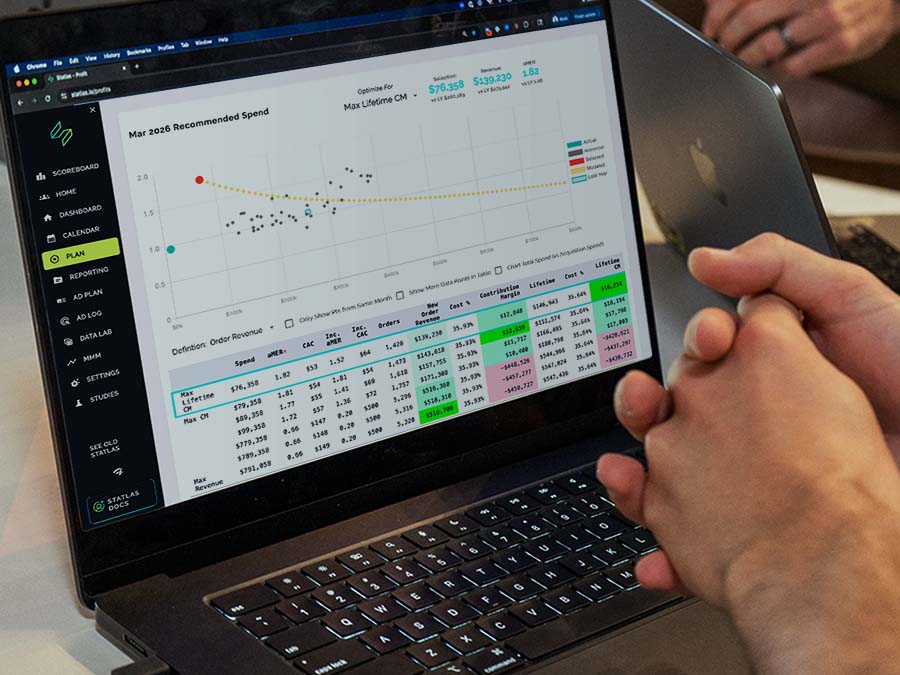
Budget decisions improve when changes are evaluated for financial impact before they are deployed. That includes understanding what happens to contribution margin when you scale another $250K.
Don’t take our word for it.
-
+5.2 ROAS with 2.5x the Sales
“By cranking ad spend while maintaining +5.2 ROAS, we’ve already done 2.5x the online sales we did last year. And we’re on track to 7x moving forward.
CTC consistently advises on new angles to test with a level of nuance and thoughtfulness that makes me wonder if they know my business better than I do. They balance our aggressive goals with the ever-changing realities of media buying in a way that results in us most effectively deploying our Facebook marketing.”

Sanjay Jenkins
Buff City Soap
-
710% YoY Growth
“Since partnering with CTC, Dorsal has grown 710% YoY. Our media buyer, Ryan, has been incredible from day one — especially his role in helping us sell internationally and positioning Dorsal’s mission from the ad creative to the copy to the landing pages.
As a marketing agency, they understand how to drive demand on social-media platforms through native, influencer, and direct-response content. Their big-picture approach then capitalizes on that demand on both social and Google.”

Chad Ross
Dorsal Bracelets


Built to serve ecommerce brands
Ready to generate profitable revenue on Facebook? Tap into the expertise of media buyers that have generated over $610 million across channels.
Get in touch:
Want more details? Keep scrolling. It’s all right here …
Want more details? Keep scrolling. It’s all right here …
Creative Is the Primary Growth Lever
Meta rewards differentiated creative and clear positioning. Audience tactics play a smaller role than they used to, which is why most brands now hit a ceiling when creative cannot keep up.
The Prophit Engine treats creative as a planned input tied to spend targets. We model creative demand so the account has enough volume and variation to scale while protecting efficiency.
That work includes structured angle testing, offer experimentation, category-level positioning, video-first asset pipelines, and creative diversification frameworks.
Creative performance issues usually show up as saturation or weak positioning, which is why creative demand planning stays tied to spend targets inside the Prophit Engine.
Profit Modeling Replaces Platform ROAS
Single account ROAS hides margin compression. Under the Prophit Engine, Meta performance is modeled using:
- SKU-level contribution margin
- Cohort-based LTV across 60 to 120 days
- Spend-to-aMER efficiency curves
- Marginal Customer Acquisition Cost (CAC) thresholds
- Payback windows tied to cash position
That model shows the marginal return of additional spend before budgets increase, so scaling decisions stay tied to profit.

Incrementality Is Measured
Meta revenue is not assumed to be incremental.
Incrementality tests are prioritized based on spend volume and expected variance, with the highest-uncertainty, highest-impact tests running first. As tests compound, uncertainty narrows and budget allocation decisions become easier to make with confidence.
What Working With CTC Feels Like
Financial performance over platform metrics.
Work is managed through structured financial reviews tied to forecast performance.
Meta’s impact on your business.
You get clear answers on where scale is safe, where saturation begins, where creative underperforms, where incrementality risk exists, and how Meta impacts blended aMER.

One unified growth system.
Meta becomes one coordinated lever inside a unified growth system, with decisions anchored in contribution margin and forecast performance.




Let’s build a Meta account that generates real profit.
If your brand spends $100K+ per month on Meta and still lacks clarity on incremental profit, let’s talk. We will review your spend curve, brand dependency, and incrementality exposure, then determine whether the Prophit Engine is the right operating system for your growth stage.